Stock and Store
Kunstraum München
11 March – 18 June 2017
curated by Patricia Drück
Matthias Wollgast presents a two-part spatial installation at Kunstraum München that brings together various aspects of his work to date, develops them further, and places them in a new context. Stock and Store can thus be understood as part of an ongoing artistic process within a broader framework that refers both to the artist’s past projects and to works already envisaged for the future.
A central concern of his work is the dependence of art on its particular context and, in connection with this, the continual revaluation of cultural values through history and reception. His practice is characterized by an intensive engagement with different formats of representation and artistic media in relation to the content they convey. In addition to exploring a wide range of modes of presentation, Matthias Wollgast explicitly incorporates into his thinking the spaces created by art and for art, treating them as formats in their own right.
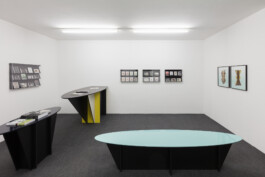
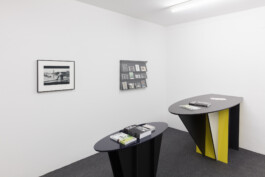
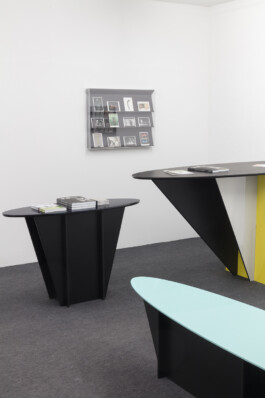
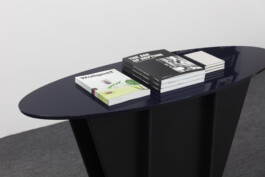
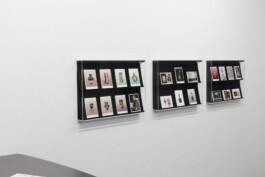
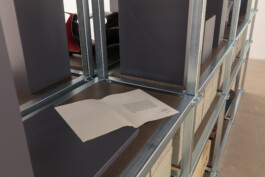
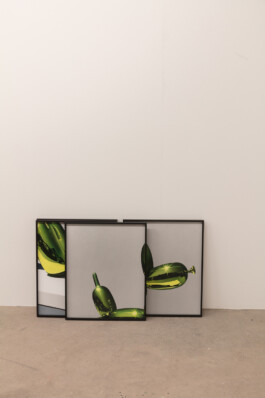
On the ground floor of Kunstraum München, a series of objects is displayed in a manner that evokes a museum shop. As viewers approach the installation, they are left to decide whether to use the furniture and the items displayed on it or to experience the installation as a self-contained work. Known and fictional works based on fictitious artist biographies, as well as works and documents from art and cultural history, are presented in the form of publications, postcards, and images. As reproductions of reproductions, they refer in part both to the original “originals” and to various existing images, objects, and presentations within Matthias Wollgast’s oeuvre. In this way, they interweave artistic content and its modes of representation across his body of work.
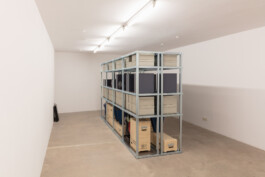
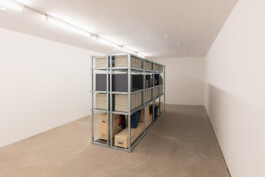
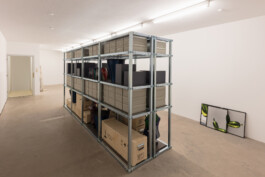
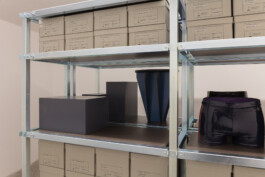
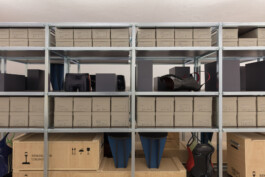
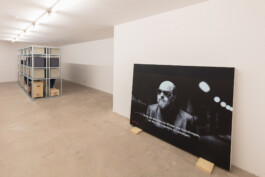
On the upper floor, Stock and Store presents “originals” in a setting resembling an archive. Transport crates and boxes are stored in a large steel shelving system, as they might be in a depot, alongside occasional plastinated objects and works by the artist. Initially, the installation’s visual and aesthetic qualities are difficult to resist. Archival materials acquire their place in cultural memory through writing, their organization, and their processing in the course of archival preservation. In Stock and Store, too, labels allude to the real or imagined contents of the otherwise neutrally designed containers, triggering associations in viewers and opening up spaces for thought.
Viewers are challenged to question whether and how this archive might be read as a concrete archive, perhaps even as the artist’s own archive, and to critically examine what historically and aesthetically exploitable insights it may offer. In the process, the interplay between an object’s material appearance and its virtual manifestation becomes palpable. The artworks themselves are transferred, through their archival setting, into an ostensibly documentary context, ultimately rendering the distinction between art and archive absurd.
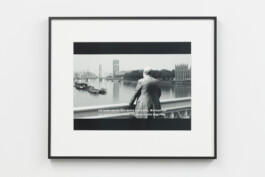
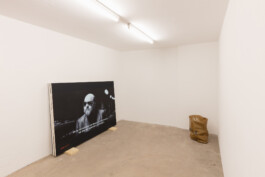
Characteristic of the artist’s practice is the way a single motif can undergo multiple layers of mediation across different media. As a film still, it is a photograph, which may in turn appear as an original or a reproduction on a postcard, in an artist’s book, or as an integral part of an installation—or even as a painting based on that photograph. Viewers are captivated by the juxtaposition of images originating in different media and by the discrepancies between an original, the object depicted, and its representation.
In Matthias Wollgast’s work, the ongoing rewriting of history and the past is continually called into question through these shifts of mediation. What is inscribed in things, and how do they change through reproduction in print media, as well as through description and interpretation? The interconnected bodies of work propose fictional narratives, question forms of (re)presentation, and at the same time allow for multiple readings that disrupt the temporal logic of a linear understanding of history.


